Validation layers and the critic loop
This page describes how OntoCast checks and repairs what the model extracts: the three validation layers, the per-unit render and critic loop with its budgets, how a critique becomes a change to the graph, and what decides whether a unit is accepted. Validation and SHACL covers the same ground from the user's side.
The three layers
| Layer | Runs | Acts on | Module | LLM calls |
|---|---|---|---|---|
| 1. Parse-time repair | Inside every facts render | The rendered unit graph | agent/render_facts.py, tool/facts_validation/literal_repair.py |
None |
| 2. Unit loop | Once per content unit, for facts and for ontology | The unit graph (facts) or the unit's delta (ontology) | stategraph/atomic.py, tool/facts_validation/unit_findings.py, tool/ontology_validation/unit_findings.py, tool/facts_validation/critic_patch.py |
One per critic or completion pass |
| 3. Post-merge gate | Once per document, after aggregation (VALIDATE_FACTS, and the same gate on /process_unit) |
The merged facts graph | stategraph/facts_gate.py, tool/facts_validation/gate.py, tool/facts_validation/shacl.py |
None |
Ontology output has its own document-level checks after the unit loop: the
reduce-time policies, STRUCTURAL_CHECK and CONSISTENCY_CRITIC, all without
LLM calls (below).
No layer withholds output. A unit that leaves the loop without being accepted keeps its graph: the reduce merges it and logs it as salvaged from a non-converged loop. The gate serves the facts it repaired, with the remaining findings attached.
The unit loop
Each content unit runs one loop per phase, written once in
run_unit_loop and parameterized by a LoopPhase (FACTS_PHASE,
ONTOLOGY_PHASE) that names the agents, the validator, the budgets and the
policies.
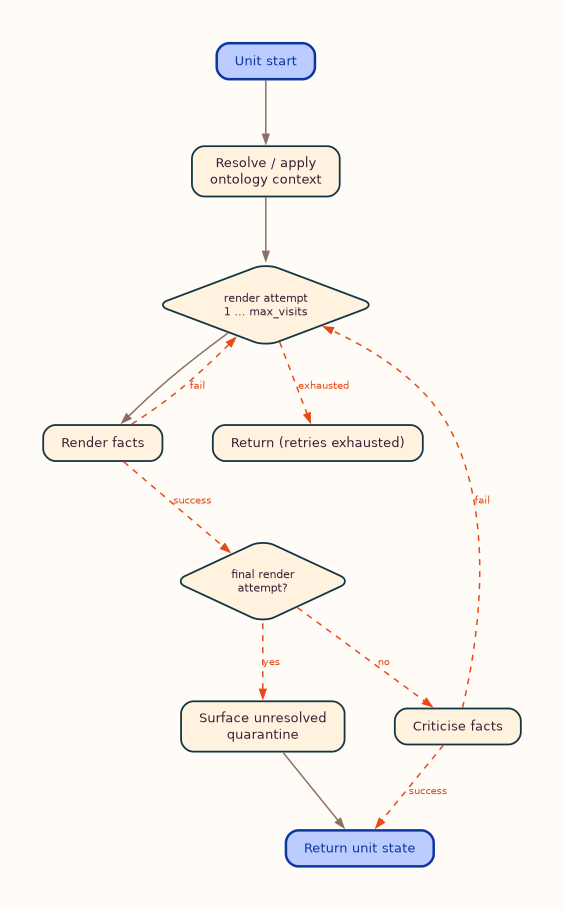
- Resolve the ontology context for the unit. For facts under per-unit shapes selection, the unit's shapes chapter is chosen from it here.
- Render. A render that fails outright (no parseable output) is retried up
to
MAX_VISITS_PER_NODE(aliasMAX_VISITS) times. A render that succeeds is never repeated: re-extracting a whole unit to fix a local defect costs a full call and brings new defects of its own. When web search is enabled and the failed render asked for it, the evidence is fetched and the render retried once within the same attempt. - Critic passes, up to the phase's budget. Each pass:
- collects the deterministic findings against the current graph (no call);
- checks whether the critic may be skipped (facts only, below);
- calls the critic, which sees the graph with numbered statements, the findings, the source text and, for facts, the shapes chapter;
- compiles the critique into one patch per fix, screens it, and applies the fixes one at a time (no call);
- re-derives acceptance from the patched graph.
- Completion passes (facts only), when enabled and measurements are still missing.
A pass ends the loop early when it kept no fix and either rolled one back or left no mandatory finding: the next pass would see the same graph and the same findings, and pay for the same answer. If the critic call fails (timeout, unparseable response), no patch is applied, the render is kept unreviewed, and the unit leaves the loop marked failed at the critique stage.
Budgets
FACTS_CRITIC_PASSESdefaults to 1, so a facts unit costs two calls: one render, one review.0leaves the findings to layers 1 and 3. In the defaultselected_single_ontologycontext mode each unit also makes one ontology selection call, counted asllm/ontology_selectioninbudget.counters.FACTS_CRITIC_MIN_TRIPLESskips the critic for a render with fewer triples; at the default it skips exactly the empty renders, which a critic would score perfect for nothing. Citation-metadata units are skipped too. A skip is recorded ascritic_skippedand bills no call.ONTOLOGY_CRITIC_PASSESdefaults to 0. The ontology loop then costs one call per unit, and its findings are collected once at the end for telemetry.FACTS_COMPLETION_PASSESdefaults to 0 (below).
All four are documented in the facts-validation and ontology-validation references.
The ontology loop
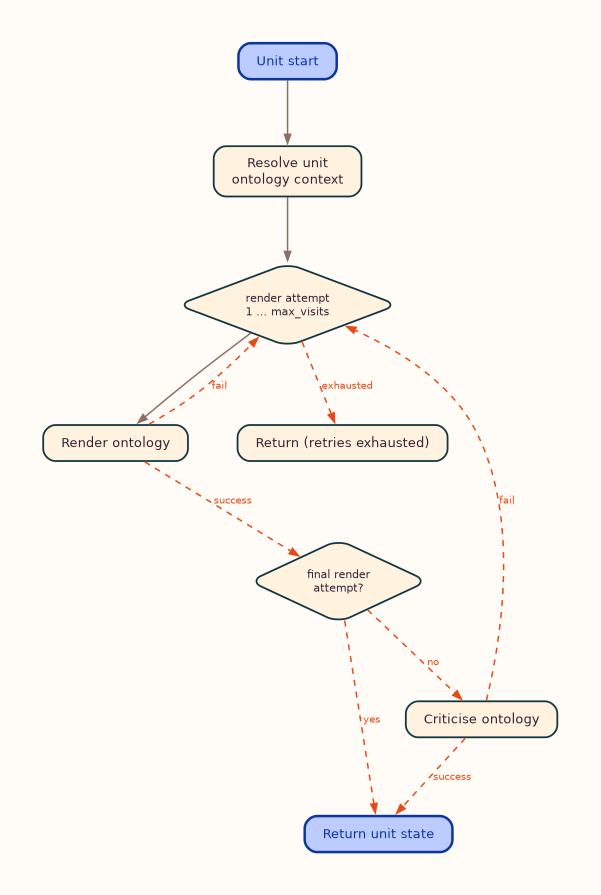
The ontology loop is the same loop with these differences:
- It renders against a copy of the unit's ontology snapshot and validates the unit's net insert/delete delta, never snapshot plus delta: that would attribute every existing catalog defect to the unit.
- It has no skip rule and no completion pass.
- Patches go through the unit's update channel, so the delta built at reduce time includes them; an update the channel refuses leaves the graph unchanged.
- The critic sees the retrieved catalog for judging term choices, but only the delta's statements carry ids, so a fix cannot delete shared catalog content.
- A rename is never allowed, and the delete limits are stricter
(
ONTOLOGY_CRITIC_MAX_DELETE_SHARE,ONTOLOGY_CRITIC_MIN_DELETES), because an ontology delete propagates to every document that uses the term. - Under
selected_vector_search_ontology, the render and critic prompts carry a partial-context notice: a term absent from the prompt may simply not have been retrieved.
Layer 1: parse-time repairs
After a facts render is parsed, _normalize_and_repair_graph rewrites what a
machine can decide without the model:
| Repair | What it does |
|---|---|
| Numeric retyping | An untyped number on a property with a numeric range gets that datatype |
rdf:type literal coercion |
A type written as a string becomes the class IRI when it resolves unambiguously |
| Compact-IRI literal coercion | A plain string such as "unit:NanoM" on another predicate becomes the IRI, when its prefix is bound and either the schema says the predicate takes an IRI or the IRI is a catalog or fallback-vocabulary term. Critic and completion patches get the same repair before they are judged |
| Near-miss predicate rewrite | A predicate not in the catalog is rewritten to the one catalog term whose name tokens contain, are contained in, or equal its own. FACTS_PROPERTY_ALIAS_MIN_RATIO only breaks ties among such candidates; string similarity alone never triggers a rewrite. A predicate the full catalog declares is never rewritten, even when the unit's snapshot lacks it |
| Code resolution | A node carrying a code from FACTS_CODE_PREDICATES (such as qudt:ucumCode "d") but no link to the coded individual gains that link, when exactly one catalog individual declares the code. The linking property comes from the schema's domain and range, or else from how the graph already links such nodes |
| Degenerate bounds | Equal lower and upper bounds become one value, when the quantity fallback vocabulary names numeric_value, lower_bound and upper_bound |
Two kinds of triple are then quarantined, removed from the graph and shown
to the critic for repair: typed literals whose lexical form is invalid for the
datatype, and string literals on a property whose range is a class
(FACTS_OBJECT_PROPERTY_LITERAL_CHECK).
Type and compact-IRI coercions, predicate rewrites and code resolutions are recorded as
GraphRepairRecords and returned per unit as facts_repairs, so a consumer can
tell a machine rewrite from what the model asserted. Ambiguity is never
resolved by guessing: two catalog terms claiming one code means no repair.
Layer 2: findings and the critic
Facts findings
collect_unit_findings runs before every critic call and after every applied
fix. Every kind is mandatory except numeric coverage:
| Finding | What it catches |
|---|---|
quarantined_literal |
A quarantined triple, with the catalog individuals of the property's range as suggestions |
unknown_term |
A term under example.org, a predicate or class minted in the facts namespace, or a term missing from a closed catalog namespace |
literal_type_object |
An rdf:type written as a string that layer 1 could not resolve |
domain_violation |
A predicate asserted on a subject whose stated type contradicts the predicate's rdfs:domain |
domain_adherence |
Too few of the render's schema terms come from the ontology context (FACTS_DOMAIN_ADHERENCE_MIN_SHARE, judged from FACTS_DOMAIN_ADHERENCE_MIN_TERMS terms up); not judged on citation or non-content units |
scalar_as_bounds |
One value written into two single-valued numeric properties of one node |
label_only_number |
A value node with a unit but no numeric literal, whose number sits only in its label |
unit_symbol_case_mismatch |
A unit whose symbol matches the text only after case folding, while another catalog unit matches it exactly |
numeric_coverage |
Numbers in the source text missing from the graph, split into measurements (number with unit) and bare numbers. Advisory unless FACTS_NUMERIC_COVERAGE_MANDATORY says otherwise; FACTS_NUMERIC_IDENTIFIER_GUARD keeps digit groups of identifiers out |
The critic is told to resolve every mandatory finding by rewriting the statement in place, never by deleting it.
Which terms count as unknown
A namespace is closed, so that a member the catalog does not list is
reported, only when the ontology context declares terms in it (uses them as
subjects). A namespace the catalog only references, such as qudt: in an
rdfs:subClassOf or owl:onProperty, is a borrowed vocabulary and stays open.
Membership is checked against the whole catalog, not the unit's snapshot: a
term retrieval did not bring into the unit is still a term.
Never reported as unknown: the built-in meta-vocabularies (RDF, RDFS, OWL, XSD,
SKOS, Dublin Core, PROV), FACTS_ADDITIONAL_STANDARD_NAMESPACES, the terms of
FACTS_QUANTITY_FALLBACK_VOCABULARY (the prompt recommends them),
FACTS_CODE_PREDICATES, and every term the SHACL shapes require. Replacement
candidates are offered only by token containment and filtered by role, so a
property is never offered as a class or the reverse.
At the gate, the shapes are cross-checked against these rules: a property the shapes require that the term validator would flag is logged as an error once per document, because no data can satisfy both.
Ontology findings
collect_ontology_unit_findings runs on the delta. Every kind is mandatory
except label_collision:
| Finding | What it catches |
|---|---|
foreign_namespace |
A term minted under a namespace no context ontology declares terms in; the reduce would drop it as unattributable. Also example.org terms and ontology terms minted in a facts namespace |
foreign_delete |
A delete of catalog content whose subject the unit does not redeclare |
subclass_cycle |
An inserted rdfs:subClassOf that closes a cycle through snapshot and delta |
role_confusion |
A catalog class used as a property, or a catalog property used as a class |
degenerate_restriction |
An owl:Restriction with too few meaningful predicates to constrain anything |
cardinality_contradiction |
A functional or max-1 declaration contradicted by a minimum cardinality of 2 or more |
missing_label |
A new class or property without rdfs:label or skos:prefLabel |
label_collision (advisory) |
A new term whose label equals an existing term's in the snapshot |
unknown_term has no ontology counterpart, since minting terms is the ontology
render's job, and connectivity is left to STRUCTURAL_CHECK.
How a critique reaches the graph
The critic cites statements by id. Every statement of the facts graph, and of
the ontology delta, carries a number in the critic's prompt (inline in Turtle,
in a TRIPLE INDEX table in JSON-LD). A fix names the ids in triple_ids:
REMOVE cites ids, REPLACE cites ids and supplies correct_value, ADD
supplies only correct_value. A fix that cites no id falls back to quoting the
statement in incorrect_value, which must match the stored triples exactly.
compile_critic_fixes turns each fix into a delete-then-insert patch, with no
LLM call. Payloads are parsed format-tolerantly: a Turtle payload under a JSON-LD
deployment, or a JSON-LD term object inside Turtle, is mapped to the equivalent
Turtle. A fix goes back unapplied, counted as residual, when it cites an id the
index never issued, names a prefix nothing declares, holds an invalid typed
literal, or would mint a placeholder subject (a name for an ignored token, or a
new node with annotations and no type). A fix that removes exactly what it
re-adds is counted as a no-op.
Screening then withholds what a pass may not destroy:
| Rule | Why |
|---|---|
| Deletes only by cited id or exact quote | A statement the critic was not shown cannot be removed |
FACTS_CRITIC_MAX_DELETE_SHARE, with a FACTS_CRITIC_MIN_DELETES floor |
Past the share a critique is rewriting, not correcting; over it, every fix that deletes goes back whole and only pure additions are kept. The floor keeps short units correctable |
A REMOVE may not empty a subject |
Removing the last statement about a node deletes the node |
A REPLACE may not write about a different subject than it deletes |
That is a rename: it orphans the old node and leaves the new one bare. FACTS_CRITIC_ALLOW_SUBJECT_RENAME opts in (facts only) |
| A blank node is deleted whole or not at all | A partial delete leaves a stub |
The surviving fixes are applied one at a time, each judged against the graph the previous kept fix left. A fix is rolled back on its own when it:
- deleted and wrote nothing (
delete_only), judged against what the fix declared it writes, so aREPLACEwhose replacement was already present is not mistaken for a bare delete; - created mandatory findings (
new_mandatory); - shrank the unit without resolving anything (
no_progress).
An applied or rolled-back fix is not requested again. In the facts phase,
applied critic fixes are recorded as critic_fix repair records.
What makes a unit acceptable
Acceptance is material_defects() over evidence that can be pointed at:
| Signal | Blocks? |
|---|---|
| Mandatory deterministic finding (facts) | Always |
Ontology finding in ONTOLOGY_ACCEPT_BLOCKING_FINDING_KINDS |
Yes; the default set is foreign_delete, foreign_namespace, subclass_cycle, role_confusion |
Critic fix at or above FACTS_ACCEPT_BLOCKING_SEVERITY (default critical; applies to both phases) |
Yes |
Critic fix with action REMOVE |
Never: a deletion is never worth holding a unit back for |
| Advisory findings | No |
The critic's score and success |
No; recorded as telemetry only |
FACTS_ACCEPT_BLOCKING_SEVERITY=never lets deterministic findings decide
alone. Acceptance is decided when the critique arrives and re-derived after the
patch, from the post-patch findings and the fixes still outstanding. It sets the
unit's status, which the reduce reads for its salvage count, and a rejected
critique may trigger the critic's web-evidence retry; it never discards the
unit's output. facts_critic_accepted counts the critic calls that accepted.
The ontology critic also records, as incumbent_accepted on each attempt, what
a score rule (success, or a score above 90) would have decided.
Completion passes
The critic judges whether what was rendered is right, not whether something is
missing. FACTS_COMPLETION_PASSES adds insert-only passes after the critic
loop, run only while the numeric inventory still lists a measurement (a number
with its unit) absent from the graph. Each pass:
- shows the model a term sheet (the unit's quantity, observation and condition classes and unit individuals) instead of the full ontology chapter, plus the unit's existing catalog-typed subjects, so a recovered measurement attaches to a node that is already there;
- keeps only
ADDfixes, whatever else the model returns; - applies them through the same one-at-a-time regression check as critic fixes.
The passes stop as soon as nothing is missing.
Layer 3: the post-merge gate
run_facts_gate runs on the aggregated graph, in this order:
- Literal variants that differ only in language tag or datatype on one
subject and predicate are collapsed (
FACTS_LITERAL_VARIANT_DEDUPE): the language-tagged form wins, then the plain one, and provenance moves to the survivor. -
Invariant checks (
validate_aggregated_facts), reported only for subjects in the facts namespaces:Finding Severity Acted on by functional_violation: two or more objects on a functional or max-1 propertyerror un-merge suspect_multi_value: two numeric values on one property; irreconcilable short strings on a property that is single-valued for most subjects; or two IRIs on such a propertyFACTS_SUSPECT_MULTI_VALUE_SEVERITYun-merge when an error degenerate_coreference: one IRI object shared by two single-valued properties of a subjecterror un-merge shaclfrom the shape autofix non_catalog_vocabularywarning reported (a retrieval miss) dangling_referencewarning reported mixed_object_kinds: a property used with both IRI and literal objectswarning reported String values on a cluster confirmed by a natural key are reported as warnings. With
FACTS_SUSPECT_MULTI_VALUE_REQUIRE_CROSS_UNIT, two IRI objects asserted by a single unit are a warning: only objects from different units can come from a bad merge. 3. Un-merge repair (document path only). The first three kinds are merge signatures: two things that are not the same got one IRI. Their clusters become pair vetoes and the units are re-aggregated, up toFACTS_MERGE_REPAIR_PASSEStimes; a pass is kept only if the merge-signature error count strictly drops. SHACL findings never drive this loop: a missing property says a node is under-specified, not that two entities were confused. 4. SHACL autofix (apply_shacl_repairs), on the graph that will be served, reusing the violations already computed. The modes and their guards are in Validation and SHACL. A pass is kept only if the violation count drops. A prune also removes a referrer the prune leaves empty, and repairs touch only nodes in the facts namespaces. Rewrites move the statement's RDF 1.2 reifier onto the replacement; prunes delete it. 5. Summary:facts_conformance,facts_validation_findingsandfacts_gate_repairs, plus the gate counters inretrieval_metrics.
SHACL runs on a copy of the data graph with the ontology context mixed in and
FACTS_SHACL_INFERENCE applied. Shapes come from the shapes partition and from
any sh:NodeShape inline in the ontology context. /process_unit runs the same
gate without step 3, since one unit has nothing to un-merge.
Ontology checks after the unit loop
The per-unit snapshot under selected_vector_search_ontology is a retrieved
subset of the catalog, so judgments that need the whole catalog run at the
reduce step, where the full catalog terminals are loaded:
| Policy | Behavior | Counter |
|---|---|---|
Minted-term reconciliation (ONTOLOGY_RECONCILE_MINTED_TERMS, default detect) |
A new term whose label, preferred label or notation exactly matches a catalog term of compatible role is a re-mint of a term retrieval did not surface. detect logs the pairs, rewrite substitutes the catalog IRI in the merged update, off skips the check |
minted_duplicates, minted_duplicate_pairs, minted_duplicates_rewritten |
| Delete policy (vector mode only) | A merged delete whose subject the merged inserts do not redeclare is dropped: it was judged on partial evidence and would change shared catalog terms | deletes_dropped_unredeclared |
| Fresh-ontology reconciliation | Units that each created an ontology under the same IRI are union-merged into one; overlap between different fresh IRIs is counted, not merged | fresh_ontologies_merged, fresh_minted_duplicates |
Applying the merged delta also counts where the unit's view and the catalog
diverged: apply_deletes_no_match (delete triples absent from the catalog at
apply time, typically a stale vector index) and
unattributed_insert_triples / unattributed_delete_triples (triples no
writable ontology claims, the loss foreign_namespace predicts).
These counters are kept in AgentState.ontology_reduce_metrics and written to
the run manifest of ontocast process under ontology_reduce_metrics. The
/process response does not include them. A minted duplicate also logs a
warning naming both IRIs.
After reduction, STRUCTURAL_CHECK checks each resulting ontology for
disconnected components and unlabeled predicates, and CONSISTENCY_CRITIC
(vector mode only) re-queries the vector store for terms that look like ones in
an ontology the document did not use. Both add to improvement_suggestions
and change nothing.
Telemetry
Per-unit attempt logs feed the critic, ontology_critic and completion
blocks of the run manifest; retrieval_metrics carries the per-document totals
(facts_critic_calls, facts_critic_accepted,
facts_critic_patches_rolled_back, facts_mandatory_residual,
ontology_mandatory_residual, the facts_shacl_* and facts_merge_*
counters). Reading run telemetry explains them.