How OntoCast works
This page follows one document from the moment you send it to the moment its graphs come back, so you can predict what a run does, what it costs, and which setting changes which step.

The steps at a glance
| Step | What happens | LLM calls |
|---|---|---|
| Convert | The file becomes text | None |
| Chunk | The text is cut into content units and labeled by section | None, unless CHUNK_SECTION_CLASSIFIER=llm |
| Ontology block | Each unit proposes changes to the ontology; the changes are merged and saved | At least one per unit |
| Facts block | Each unit's facts are extracted, then merged into one graph and validated | At least one per unit |
| Serialize | The graphs are stored and returned | None |
Convert
OntoCast turns the input into text. PDF, Word, PowerPoint, Excel, HTML, Markdown, CSV, AsciiDoc and image files go through a
document converter (the doc-processing extra;
CONVERTER_SUPPORTED_EXTENSIONS
lists the suffixes); .txt, .json and .jsonl input is read as is. Each PDF is checked for a text layer
(CONVERTER_PROFILE=auto): one with selectable text,
including a scan with an OCR layer, converts with OCR off; one whose pages are images only converts with OCR on.
Equations stay placeholders unless the lean profile or
CONVERTER_DO_FORMULA_ENRICHMENT
decodes them to LaTeX, which runs a model per equation.
Chunk
A document is too long for one prompt, so OntoCast cuts it into parts (content
units) of between
CHUNK_MIN_SIZE and
CHUNK_MAX_SIZE
characters. Cuts follow the document's sections, so no unit spans two labeled
sections, and every unit carries the label of the section it came from, such as
methods or results. Neighbouring sections that got no label are joined
until the unit reaches the minimum size, and a heading with no text of its own
opens the unit that follows it.
Section labels decide what is extracted at all: reference lists are skipped by default, and you can ask for only some sections of a document. Structured documents explains labels, filters and the optional per-unit summary.
From here on, every unit is processed on its own and in parallel, up to
PARALLEL_WORKERS
at a time.
The ontology block
The ontology block grows the ontology the facts will be expressed in. It runs
when RENDER_MODE is
ontology or ontology_and_facts.
- Choose the ontology context. Each unit is shown the slice of the catalog
it needs: one ontology the model picks, the terms vector retrieval finds, or
one fixed ontology, depending on
ONTOLOGY_CONTEXT_MODE. See Choosing ontology context. - Render. The model reads the unit and its ontology context and proposes new classes and properties as a patch: triples to insert and triples to delete. With an empty catalog it starts a new ontology.
- Review. An optional critic reviews the patch; see the per-unit loop below.
- Merge and save. When every unit is done, their patches are merged into one change per ontology. A triple one unit inserts wins over another unit's delete of it. Each new term goes to the ontology that owns its namespace, and every ontology that changed becomes a new version. What each unit contributed is kept apart from the ontology itself, as provenance.
- Consolidate (optional). With
ENABLE_ONTOLOGY_CONSOLIDATION, one more LLM call refines the ontology against an excerpt of the whole document. It runs only when the document produced exactly one ontology. - Structural check. OntoCast checks the ontology for disconnected parts and
properties without labels. It changes nothing; problems are reported in
improvement_suggestions. - Consistency check. In
selected_vector_search_ontologymode, the new terms are searched against the whole catalog to find near-duplicates in ontologies the document did not touch. This is a retrieval, not an LLM call, and its findings are also reported inimprovement_suggestions. In the other modes the step does nothing.
Ontologies and facts explains versions, patches and provenance.
The facts block
The facts block extracts what the document states, in the terms of the
ontology. It runs when RENDER_MODE is facts or ontology_and_facts.
- Choose the ontology context. After an ontology block, every unit is shown
the ontologies this document just updated. In
factsmode each unit gets its own context, chosen as in the ontology block. - Render. The model extracts the unit's facts as a graph. Every new entity
goes into the facts namespace
cd:; the ontology's terms are only used, never changed. See the two-namespace contract. - Review. Deterministic checks and the critic review the facts, and fixes are applied to the unit's graph; see the per-unit loop.
- Merge. The units' graphs become one. Two units often describe the same thing under different names, so OntoCast decides which entities are the same and merges them; see Entity disambiguation.
- Validate. The merged graph is checked as a whole: a property that may have one value but has two, one entity filling two single-valued roles of the same subject (a range whose bounds were merged), and, with shapes loaded, SHACL violations. A finding that points to a wrong merge undoes that merge. See Validation and SHACL.
Serialize
The ontologies and the facts are written to the triple store (in memory, or
Apache Jena Fuseki; see Triple stores) and
returned as Turtle. Ontologies are stored as new versions; facts are stored in
a named graph of their own for each document. /process returns them with the
run's telemetry; ontocast process writes them to files, along with a run
manifest. See Reading run telemetry.
Which blocks run
RENDER_MODE |
Ontology block | Facts block |
|---|---|---|
ontology_and_facts (default) |
Yes | Yes, against the updated ontologies |
ontology |
Yes | No; no facts are written |
facts |
No; the catalog is not changed | Yes, against the catalog as it is |
Configuring OntoCast explains when to use each.
The per-unit loop
Inside each block, every unit runs the same short loop:
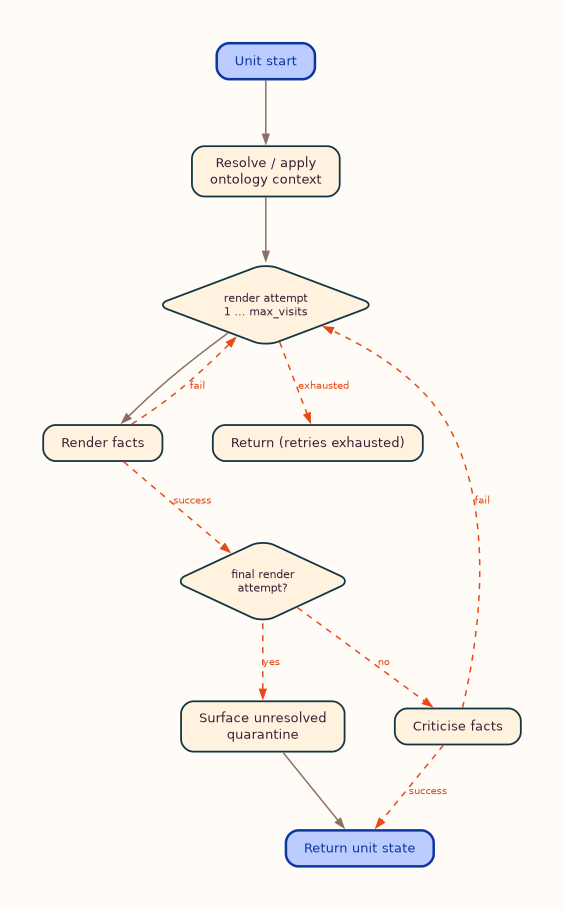
- Render is one LLM call. If it fails outright (no usable output), it is
retried up to
MAX_VISITS_PER_NODEtimes. A render that succeeded is never repeated. - Review is a critic pass: deterministic checks first, at no cost, then one LLM call to the critic, which points at the statements to fix. OntoCast applies the fixes itself, as a patch, without another LLM call, and undoes any fix that makes the unit worse. The loop stops early once another pass would see the same graph and findings.
- How many passes is set per block:
FACTS_CRITIC_PASSES(on by default) andONTOLOGY_CRITIC_PASSES(off by default). - Completion passes (facts only, off by default) ask the model for
measurements the render missed, adding facts and never removing any; see
FACTS_COMPLETION_PASSES.
So at the defaults, an ontology unit costs one call and a facts unit usually
two, plus, in selected_single_ontology mode, one call per unit for choosing
the ontology.
Validation layers describes the checks, the
fixes and their limits in detail.
Processing one unit
POST /process_unit and run_unit_pipeline run the per-unit loops on a
single piece of text, with no conversion, chunking or merging. Use them to
call OntoCast from your own pipeline, one passage at a time; see Embedding
OntoCast in your agent.
What to read next
- Ontologies and facts: versions, patches, provenance and the facts namespace.
- Structured documents: extracting from only some sections.
- Entity disambiguation: when two entities become one.
- Glossary: the terms used across these pages.