OntoCast  

Agentic ontology-assisted extraction of RDF knowledge graphs from documents.






OntoCast turns unstructured text into queryable RDF: it co-evolves domain ontologies and fact graphs in a parallel map/reduce pipeline, with RDF 1.2 provenance, entity disambiguation across chunks, and optional vector-backed ontology retrieval. Run it as a REST service, a batch CLI, or embed the pipeline in your own LangChain / LangGraph agent.
Why OntoCast
Most extractors dump triples and leave ontology drift to you. OntoCast treats schema and instance data as one loop: per-chunk render → critic → merge, with GraphUpdate patches (insert/delete) instead of regenerating whole graphs, SHACL validation with LLM-free autofix, and a light install so you can embed the core without pulling Docling, gRPC, or ONNX.
Features
- Parallel ontology + facts loops — concurrent per-unit render/critic with configurable workers
- GraphUpdate patches — token-efficient insert/delete ops, not full-graph regeneration
- Entity disambiguation — embedding + symbolic alignment across chunks
- RDF 1.2 provenance — quoted triples / provenance artifacts; optional
strip_provenance - Ontology context — catalog selection, vector retrieval (LanceDB or Qdrant), or a fixed ontology
- Facts validation — invariants, SHACL, and machine repairs without an extra LLM pass
- Stores — in-memory pyoxigraph by default; Fuseki for persistence; tenancy by tenant/project
- LLM caching — disk cache, in-flight limits, optional read-only / batch pre-warm
- Embeddable —
ontocast_tools,run_unit_pipeline, or a LangGraph node
Install
Pick at least one LLM provider extra. Add server for the CLI and HTTP API:
Common add-ons: doc-processing (PDF/DOCX), lancedb or qdrant (ontology retrieval), shacl (shape validation).
See Installation for the full extras table.
Quick Start
cp .env.example .env
# Set LLM_API_KEY (and LLM_PROVIDER / LLM_MODEL_NAME as needed)

ontocast serve
curl -X POST http://localhost:8999/process -F "file=@document.pdf"
Batch without a server:
Omit FUSEKI_URI for in-memory pyoxigraph. Details: Quick Start Guide.
Supplying Your Ontologies
OntoCast uses seed ontologies (in Turtle .ttl format) to guide extraction. Provide yours in two ways:
- Directory Seed: Set
ONTOCAST_ONTOLOGY_DIRECTORY=/path/to/your/ontologiesin your.env. All.ttlfiles in that folder sync automatically on startup. - API Upload: Register schemas dynamically with the running server:
Configuration
Start from .env.example.minimal — 47 variables instead of 202, grouped by the
decision they belong to. Then pick a playbook for what
you are actually doing: evaluating, building an ontology, populating facts,
scaling to a large catalog, or serving it.
The knobs that change what the pipeline does — as opposed to where it stores things:
| Variable | Default | What it controls |
|---|---|---|
RENDER_MODE |
ontology_and_facts |
Which halves run. ontology writes no facts; facts skips the ontology block and extracts only against the catalog you already have — see Render Mode |
ONTOLOGY_CONTEXT_MODE |
selected_single_ontology |
Where each unit's schema comes from: LLM catalog selection, vector retrieval, or one pinned ontology — see Ontology Context |
LLM_GRAPH_FORMAT |
jsonld |
Wire encoding the LLM emits graphs in; turtle is the legacy alternative |
MAX_VISITS_PER_NODE |
1 |
Render/critic retry budget. At 1 the LLM critic never runs |
PARALLEL_WORKERS |
16 |
Concurrent content-unit workers |
LLM_PROVIDER / LLM_MODEL_NAME / LLM_API_KEY |
openai |
Provider selection and credentials |
ONTOCAST_ONTOLOGY_DIRECTORY |
— | Seed ontologies synced on startup |
FUSEKI_URI |
— | Triple store; unset means in-memory pyoxigraph |
RENDER_MODE, ONTOLOGY_CONTEXT_MODE and LLM_GRAPH_FORMAT are also
per-request parameters on /process. Full surface, including chunking,
retrieval and validation: Configuration System.
Embed in your agent
from langchain.agents import create_agent
from ontocast import Config, ToolBox, ontocast_tools

tools = await ToolBox.acreate(Config.in_memory())
await tools.initialize()

agent = create_agent(
    model,
    tools=[*ontocast_tools(tools)],
    prompt="Edit the ontology from the user's text.",
)
Also: run_unit_pipeline for a single passage, or make_ontocast_node inside your own LangGraph — see Embedding OntoCast.
Workflow
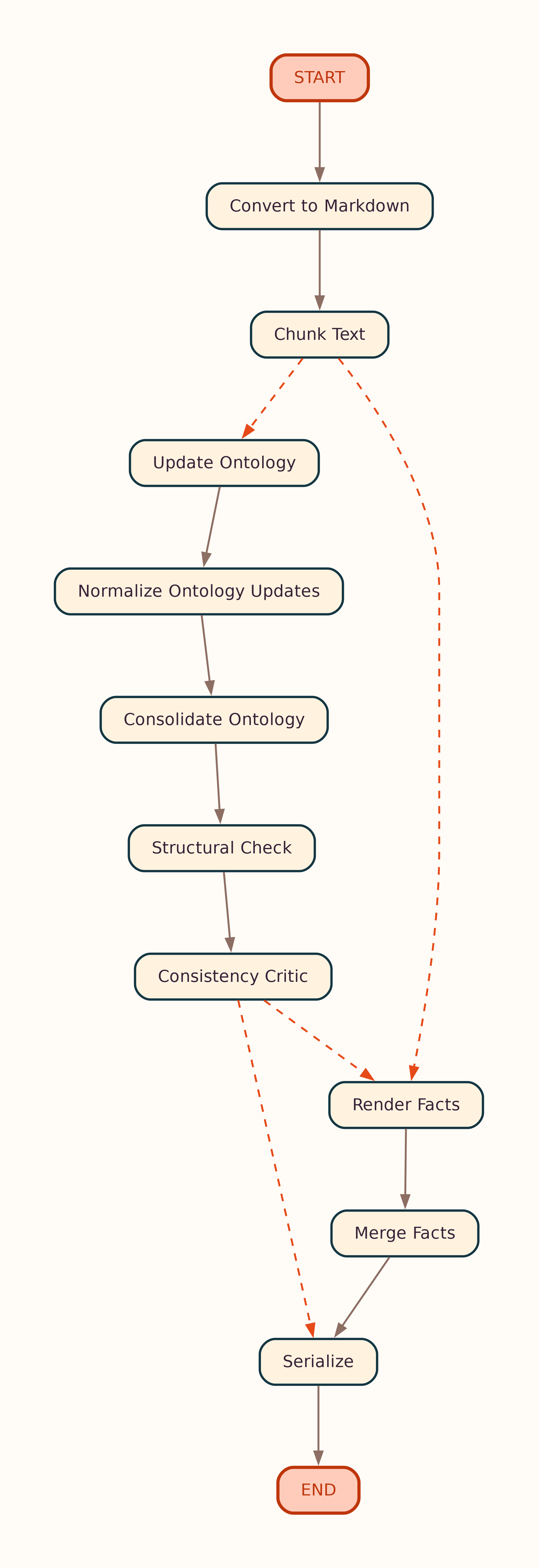
- Convert → chunk prepare (segment, tag, filter, size)
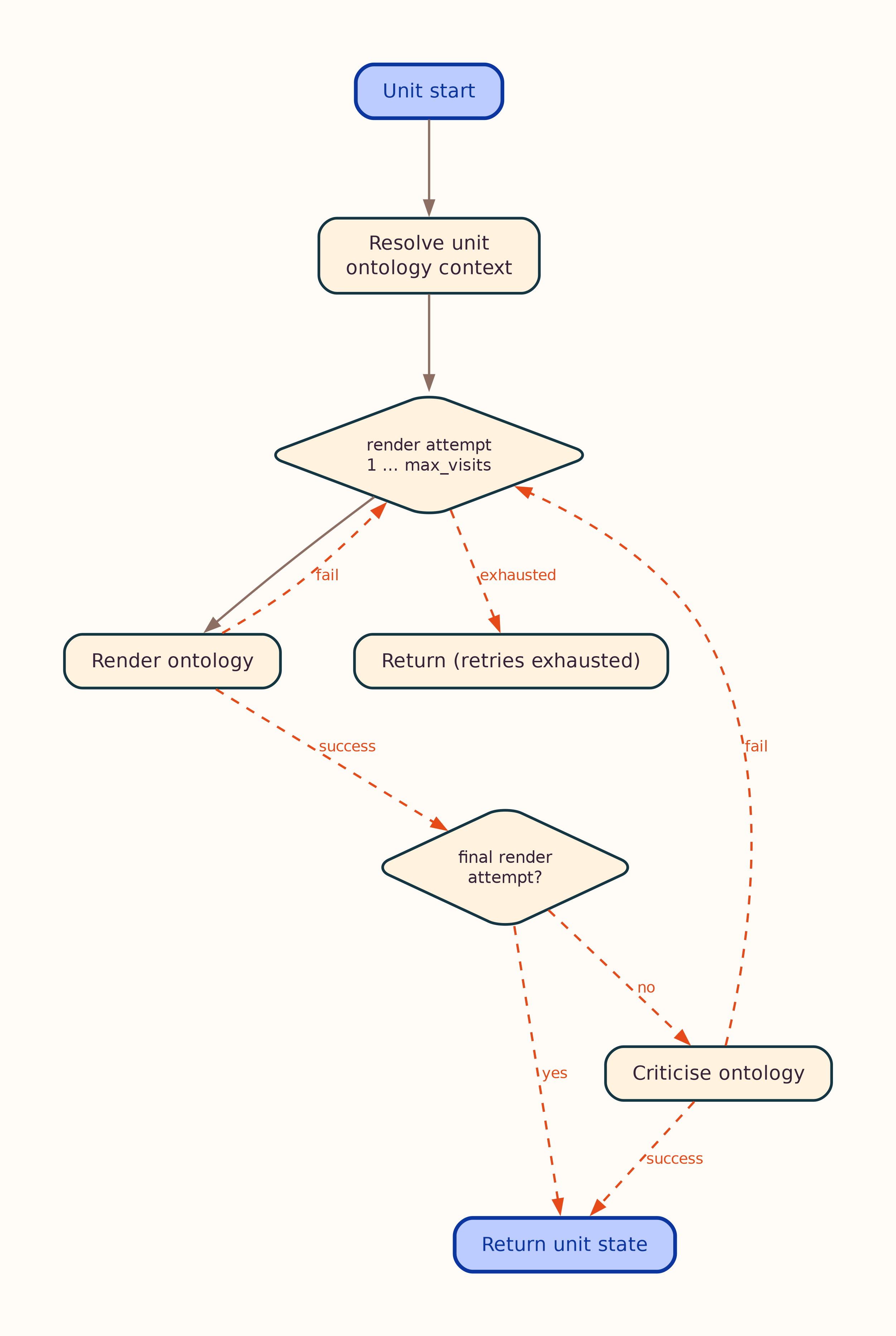
- Parallel ontology render → normalize → consolidate → structural check → critic
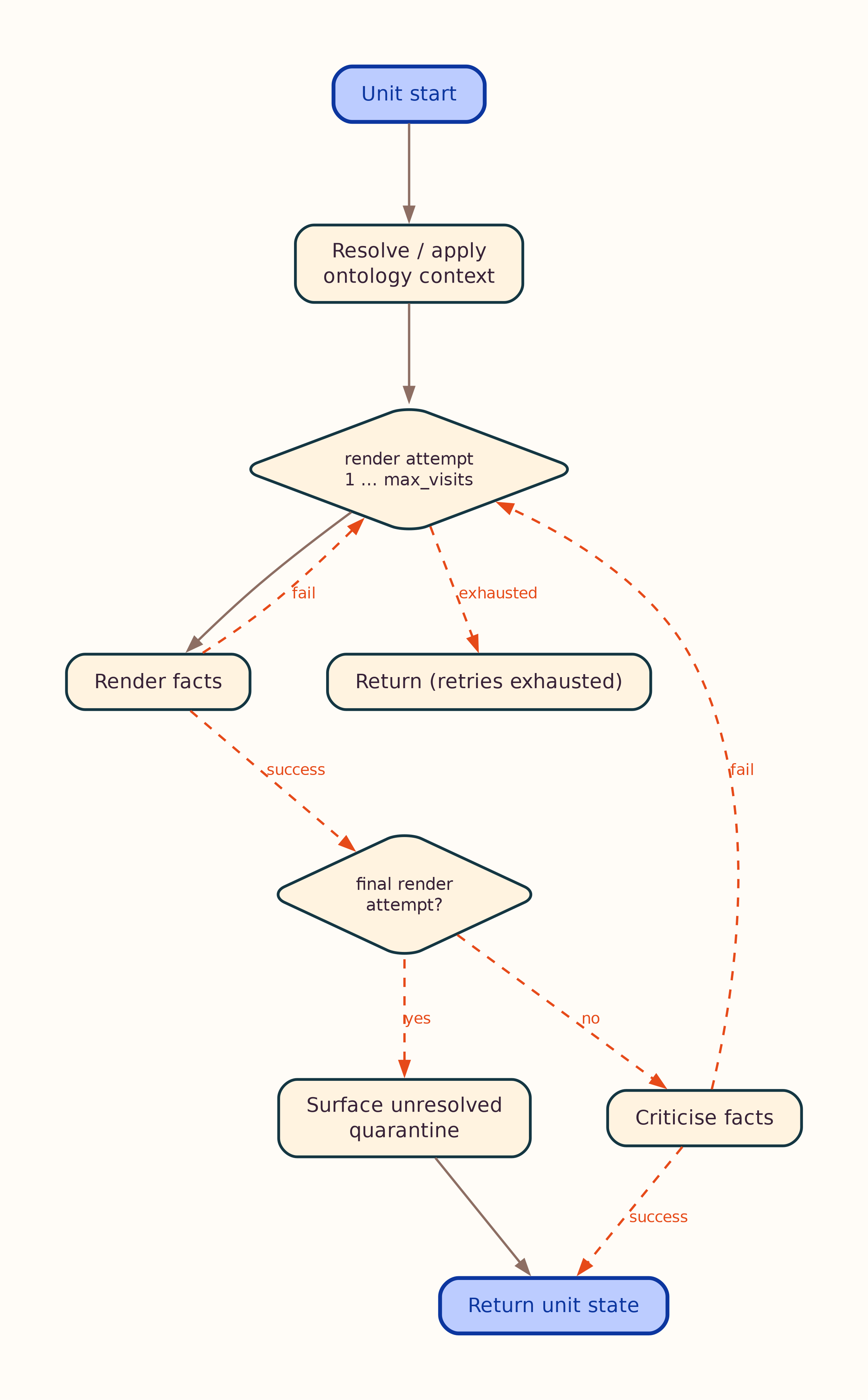
- Parallel facts render → merge / disambiguate → validate (invariants, SHACL, autofix)
- Serialize to the triple store; return Turtle from the API
Workflow Guide · landscape: graph.lr.png · per-unit: ontology_loop, facts_loop

Documentation
Browse the complete documentation using the sidebar or start with these core guides:
| Installation · Quick Start | Getting started |
| Core Concepts · Workflow Guide · Configuration System | How it works |
| API Endpoints · Embedding OntoCast · Tenancy | Integrate |
| Ontology Context · Validation / SHACL · Triple Stores | Operate |
| API Reference | Python API |
Release notes: CHANGELOG
Contributing
We welcome contributions! See the Contributing Guide for guidelines, and feel free to open issues or discussions on GitHub.
License
This project is licensed under the Apache License 2.0 — see the LICENSE file for details.