Example 20: Version control for a world model — fork, conflict, resolve, merge
Two people start from the same schema. One decides the SSN identifies a person; the other decides the email does. Both are right about their own half of the business, and a registry that stores versions in a line has nowhere to put that: the later write wins, silently, and the disagreement becomes a bug someone finds months later in the data.
A commit DAG puts it somewhere. Both branches are recorded, both replay from the base, and the history states plainly that it has two heads. Reconciling them is a separate, explicit act that produces a third commit naming both parents — and records how the disagreement was settled, so the same decision does not have to be made twice.
No database. A commit history is a fact about the contract, not about any deployment of it.
Prerequisites
- Python 3.11+
- GraFlo package (run from the example directory with
uv run) - No database. Everything here is the contract plane.
The shape
                  78397faf  key people by email    ← head
                 /
97382d5d ───────┤                                    f26ae87f  merge
 created_at      \                                  /
                  f42a0133  key people by SSN  ─────┘  ← head
The shared commit matters: without a common ancestor there is nothing to merge against, and combining two unrelated lineages is merge, not merge.
Why each branch changes two things
Each branch re-keys the vertex and adds a property the other does not
contest. That is not padding. If the identity were the only difference, taking
one side would reproduce that side exactly, and build_multi_parent_commit would
rightly refuse — a commit that moves nothing is a lie about history. With both,
the merge is a real merge: one side's decision wins the contested slot, and
both sides' uncontested work survives.
Slots
Reconciliation happens per slot — the addressable location an op touches.
The two re-keys both land on vertex/person/identity, so they collide. The two
property additions land on different field slots, so they merge with no
question asked. That is the whole mechanism: conflicts are scoped to where the
disagreement actually is.
A conflict carries both sides' ops and the ancestor's state, because "what did this look like before either change" is the question a resolver needs answered and the one a two-way diff cannot express.
Run it
No live graph database required.
cd examples/20-version-control
uv run python build_history.py              # → artifacts/commits/, two heads
uv run python build_history.py --show       # the log, without rewriting
uv run python merge_branches.py             # the conflict, resolved by taking left
uv run python merge_branches.py --take right
uv run python merge_branches.py --advance-left
The same history through the CLI:
uv run graflo log --store artifacts/commits
uv run graflo checkout --base manifest.yaml --store artifacts/commits <commit>
uv run graflo verify --base manifest.yaml --store artifacts/commits
Tracked merges
--advance-left is the flag worth understanding. It moves the left branch on
(the vertex gains nickname) and then runs the recorded merge again:
replayed the recorded resolution:
  note: 1 recorded resolution(s) replayed: vertex/person/identity

merged (took left):
  identity  : ['ssn']
  properties: [..., 'ssn_verified', 'nickname', 'email_verified']
The identity decision is not asked again — it is replayed from the recipe, which is content-addressed with its resolutions hashed in slot order. Only genuinely new conflicts would surface. That is what keeps an overlay maintainable instead of a fork someone re-litigates every release.
A recorded resolution whose slot stops conflicting is reported as unused rather than force-applied: re-applying a stale decision to a slot nobody contested is how a re-merge quietly reverts someone's work.
What to look for
- The fork is a recorded fact.
build_history.pyprints two heads. Nothing was dropped and nothing was overwritten to get there. - Both sides' uncontested work survives. The merged vertex carries
ssn_verifiedandemail_verified, whichever side won the identity. - The merge commit names both parents, and materializes its ops against the first — which is what lets verified replay treat it like any other commit.
- Taking the other side changes the hash, not just the identity: content addressing is over the whole model.
- The merged manifest is stamped with
content_hash,canon, both parents and the recipe hash, so it is self-describing outside any store.
Seeing where they met
A conflict list says what; the slot tree says where. Slots are paths that
contain one another, so vertex/person sits above the field edits inside it,
and a rename colliding with three of them reads as one conflict about the
vertex rather than three about fields that happen to live there.
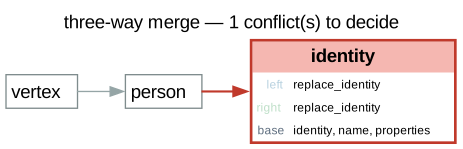
The contested slot carries both branches' ops and the ancestor's state — the question a decision actually turns on, and the one a two-way diff cannot answer. Alongside it, the lineage, with first-parent edges solid because that is the line a commit's ops are a diff along, and the common ancestor marked:
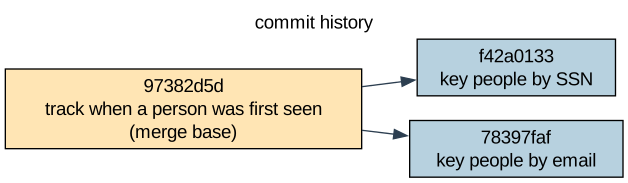
graflo merge --plot slots.svg --plot-history lineage.svg draws the same two
from the shell. Both are written before the unresolved-conflict refusal, not
instead of it.
Files
| File | Purpose |
|---|---|
manifest.yaml |
The base world model: a person keyed by id. |
build_history.py |
Records the shared commit and the two branches; prints the log. Importable and side-effect free. |
merge_branches.py |
Finds the ancestor, shows the conflict, resolves it, records the merge commit, and replays the recipe under --advance-left. |
artifacts/commits/ |
The recorded history, one YAML per commit. |
Related documentation
- Version control — content addressing, the commit DAG, slots, tracked merges
- Manifest evolution — the op vocabulary a commit records
- Vertex identity — what re-keying a vertex actually changes
- Example 19 — merging two unrelated manifests by declared equivalence, which is the operation to reach for when there is no common ancestor
- Example 17 — identity funnels, for when the right answer is "whichever key this record actually carries" rather than one side winning