OntoMeter Corpus
A corpus of public ontologies, processed into tables: what each ontology is, how ontologies depend on one another, and how abstract and how reused they are. The ontologies come from ten public registries (six OntoPortal Alliance instances, OBO Foundry, Ontohub, Open Knowledge Graphs and LOV), parsed and deduplicated across registries and versions.
Why a corpus of ontologies
Reuse is the premise of the semantic web: a new ontology should build on the vocabularies that already exist rather than define its terms again. Whether that happens, and around which ontologies, is hard to see from any one place.
- The population is scattered. Ontologies sit in several registries that overlap, mirror one another and keep many versions of the same file, so counting from a single registry over-counts some ontologies and misses others.
- Reuse takes many forms. An ontology can
owl:importanother, use a few of its terms without importing it, or declare its own classes under another's classes. Each form says something different about dependence. - Abstractness is relative. Whether a term is general or specific, a class or an instance, depends on how the other ontologies use it, which only a population shows.
The corpus answers these with one population: each ontology counted once, the dependency network between ontologies with every edge traceable to the triples behind it, and measures of generality and reuse for terms and for ontologies. With it you can ask which ontologies the rest build on, how concentrated reuse is, how one ontology compares with all the others, and how the network grew over time.
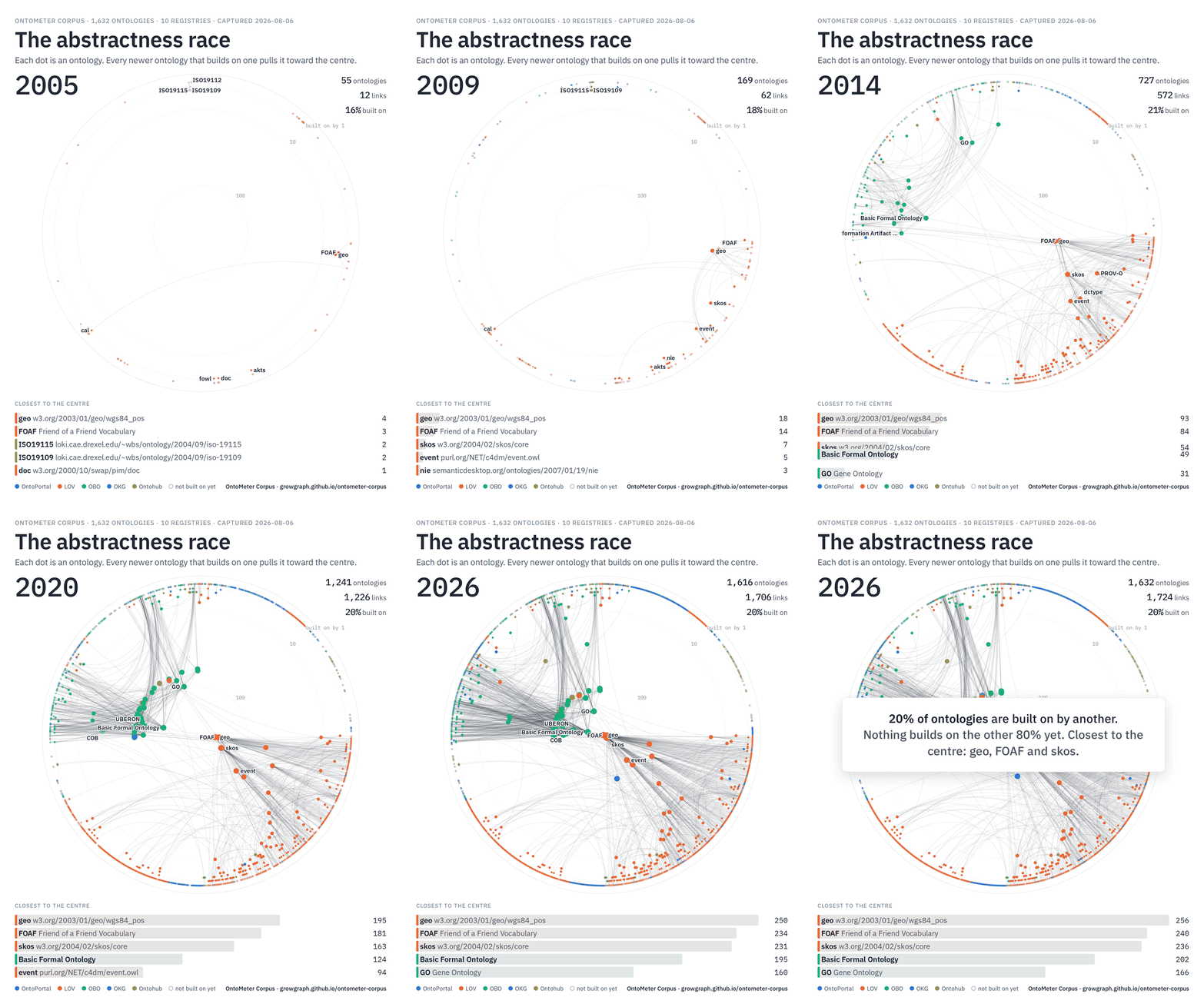
The abstractness race. Each dot is an ontology; a link means one ontology declares classes under another's. As the corpus grows, the ontologies others build on are pulled toward the centre. Explore it year by year.
What the repository holds
- The tables, in
data/, versioned in git and released ascorpus-YYYY-MMtags;data/release.tomlnames the release and its table format. They are plain Parquet, SQLite, JSON Lines and TSV, so reading them needs no package. - The
ontometer-corpuspackage, which loads the tables, derives them from the raw ontology files, and regenerates the figures and numbers of the paper that describes the corpus.
The raw ontology files are not in the repository; they live in an object store.
Where to start
The pages follow the order in which a new reader needs them:
- Install and use: install the package and load the network in a few lines.
- The tables: what each file holds and how the files join.
- Measures: what the columns mean. Abstractness defines generality and class-likeness, Dates places ontologies in time, and the abstractness race shows both at once.
- Pipeline: how the tables are made, from the overview of every step to rebuilding them and what a rebuild reproduces.
- The paper: regenerate every figure and number of the paper from the tables.
I want to...
| I want to... | Read |
|---|---|
| Install the package and run a command | Install and use |
| Know what each table holds and how the tables join | The tables |
| Measure how general or how class-like a term is | Abstractness |
| Know where the dates come from | Dates |
| Watch the network of ontologies grow | Abstractness race |
| See which command writes which table | Overview |
| Fetch, parse and deduplicate ontologies | Fetch, parse, dedup |
| Get, check, extend or publish the raw files | Object store |
| Know what a node and an edge of the dependency network mean | Dependency network |
| Rebuild every table, and know what a rebuild reproduces | Rebuilding |
| Regenerate the paper's figures and numbers | The paper |
| Call the code from Python | API reference |